From problem anchor to problem hypothesis
Since the beginning of building Republik, the prospect's problems have always been the center point. It is the single most useful thing to build an approach on because it is what connects you with your future customers.
We have called this the problem anchor. But today we shift that thinking. The playbooks have always been very confident in how it reads the account signals and then picks the core problem while showing you the other problems as well.
Sometimes the problem is evident from public signals, but most times it was not as certain as Legatus let on. It was stated on facts inside companies we could not see, and lack of evidence was treated as a gap at the account, not in the research.
So it could confidently guess wrong.
Today we introduce the replacement: The problem hypothesis
Legatus 1.2 changes the posture. It no longer tells you what the problem is. It tells you what the problem most likely is and shows its work.
The language is softer on purpose. "They have this problem" becomes "this is most likely their core challenge."
Every hypothesis is built the same way:
What the company visibly does. Its hires, its moves, its own words.
Where that most likely breaks. The pain those facts point to.
What we can't see from outside. Said plainly.
The question that tests it. One question for the first conversation.
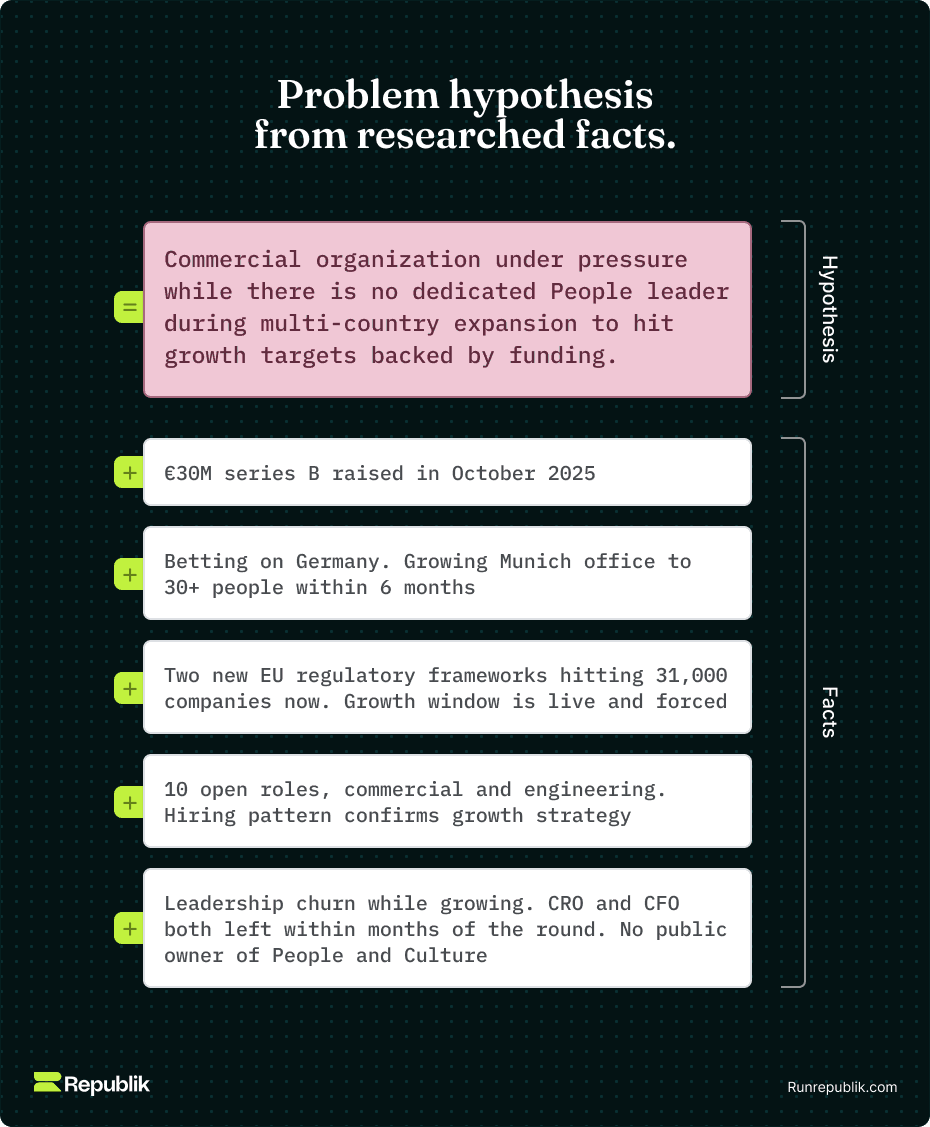
When public signals point straight at the problem, the facts carry the hypothesis. A funding round, an expansion, open roles and leadership churn add up to one likely challenge. You see every step.
When the signals are thin
Some accounts show the problem in public. Others only show the conditions for one. A certification. A Trust Center. A deadline on the horizon.
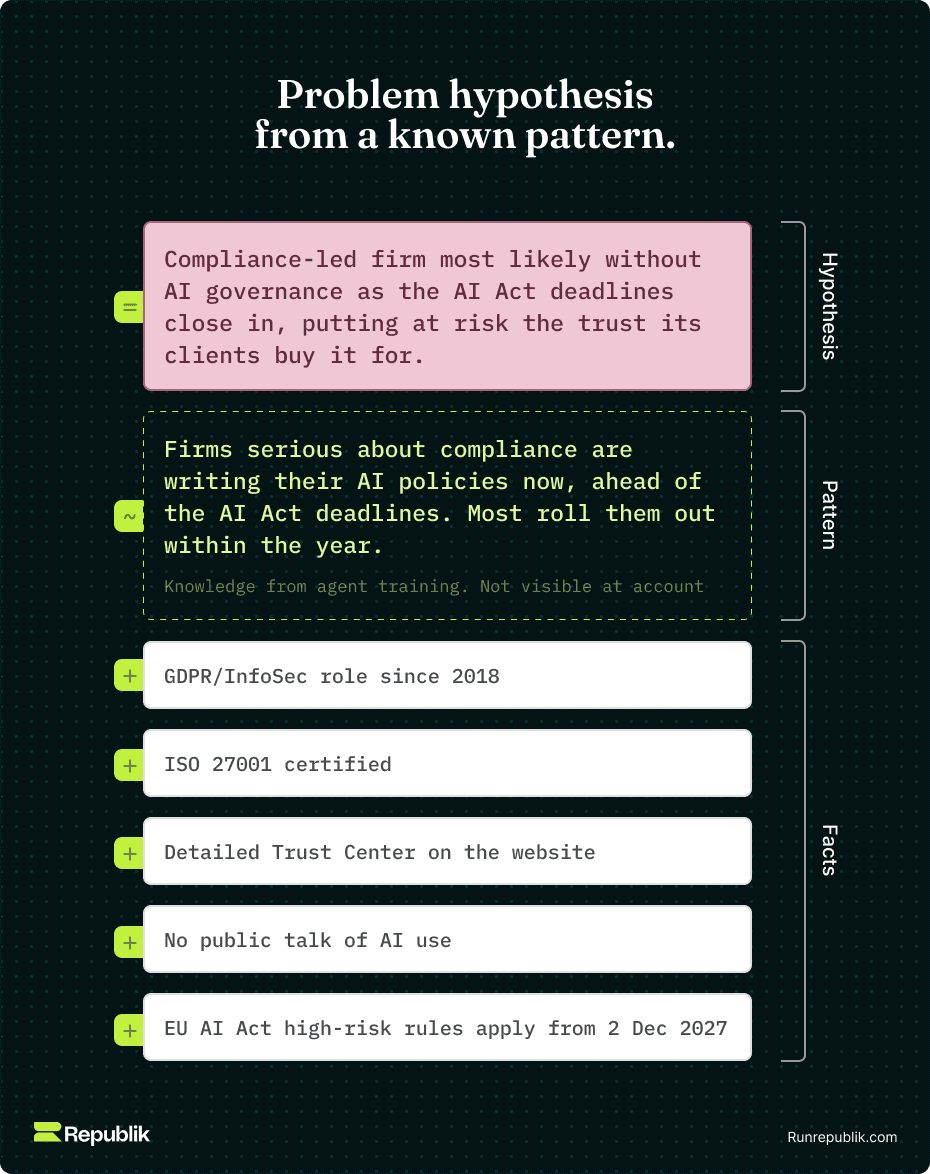
Before, Legatus filled that gap with a guess. Now it reaches for a pattern. What usually breaks at companies in this situation. And it labels it clearly as a pattern.
The pattern comes from your agent training. A study, a benchmark or a case from your content library. So your own material does the work.
Same method every time. Where the problem shows, the hypothesis rests on those facts. Where only the conditions show, a pattern bridges the gap. Either way, the rep knows how sure the playbook is. And can still say it out loud.
What you see
Why this account reads as a short story. What is happening, the likely pain, the signals. It ends on one line: Problem hypothesis.
The Core challenge card on the Brief carries that same line. Word for word.
Intelligence holds the longer argument. What the company does today, the most likely break, what we cannot see and the question that tests it.
The approach opens with that question.
When the research could not find something, the playbook says it is not visible. Never that it is missing.
You have access to it now. It takes effect on each account's next playbook. Existing playbooks stay as they are.
Also shipped
Legatus 1.2
Added sitemap search on the account's own website, so the agent can better find the right pages to read. Your agent training steers what the agent looks for in the sitemap.
Clearer notes on pages it cannot read, and why.
Problem fit is reworked into four levels: Strong, Good, Possible and Weak. Strong needs a dated event that makes the timing right now.
Fixes and improvements
Rebuild Playbook no longer shows a false "failed" while research is still running.
The Accounts list and the Brief no longer show a company at two different sizes.
Better timing. Events older than 12 months no longer slip into the playbook as fresh triggers.
Employee counts the company states itself are shown rounded, like "40~". Anything else shows as a size group, like "11-50".
Problem fit and ICP now sit as two pills on one colour scale, with a hover that explains each level.
← All changes